

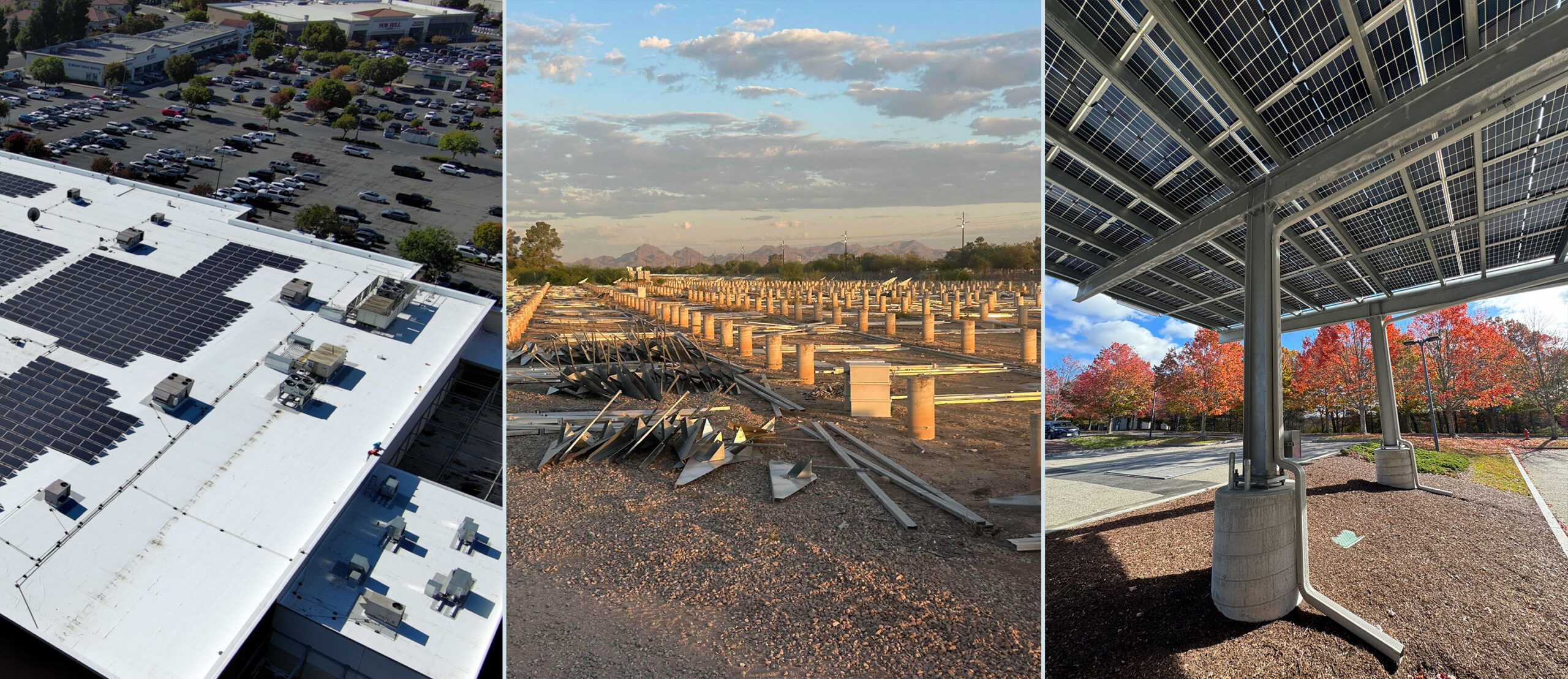
Solar arrays may look similar from a distance, but where they are installed changes what it takes to remove, replace, or repower them. At Decom Solar, we work with all three types of projects: rooftop, carport, and ground.
When we look at these at a high level, a system on a roof is often connected to the future of the building, a carport must work around a parking lot that people use every day, and a ground mount may require a plan for the land beneath it.
At a glance
| Rooftop | Carport | Ground mount | |
|---|---|---|---|
| Expected panel life | 25–35 years | 25–35 years | 25–35 years |
| Illustrative system size | 250 kW DC (0.25 MW) in a U.S. Department of Energy commercial rooftop benchmark | 94 kW (0.094 MW) at one federal facility; larger projects can reach multiple MW | 100 MW DC in a DOE utility-scale benchmark; smaller ground mount projects also exist |
| What determines the footprint | Usable roof area, structural capacity, and space needed for other roof equipment | Number and layout of parking spaces, canopy design, and vehicle access | Available land, array layout, access routes, and site conditions |
| What may prompt earlier work | Roof repair or replacement can require temporary panel removal | Parking lot or canopy work may affect the array | Repowering or a change in land use may prompt partial or full removal |
| What decommissioning must account for | Roof condition and coordination with roofers | Parking access, canopy components, and the parking surface | Foundations, equipment removal, and any required land restoration |
System sizes are illustrative examples, not typical or average project sizes.
Understanding those differences early helps asset owners avoid treating decommissioning as a last-minute equipment removal job. Here’s a breakdown of all three types:
Rooftop solar puts otherwise unused building space to work. The panels and the roof do not always reach the end of their useful lives at the same time, however.
Imagine a roofer showing up to a job having to navigate the foreign and specific demands of a solar array, too!
If a roof needs repair or replacement while its solar array is still productive, the system may need to be temporarily removed and recommissioned afterward. That work calls for coordination among the asset owner, solar team, and roofer. Equipment must be handled and stored appropriately, and the roof needs to be ready for the array to return.
For a rooftop system, the planning question is:
Answering it before approving a roofing project can help owners evaluate which components should return to service and which may be candidates for replacement, reuse, or recycling. We have an incredible track record working successfully with both roofers themselves and asset owners of roof-mounted solar systems.
Solar carports make one space serve two purposes: generating electricity and providing shade over parked vehicles. Their elevated structures also make decommissioning a site operations project.
When we think of these projects, we have to think about more than modules. Work may affect parking availability, traffic flow, and access for customers, employees, or tenants. If the project involves more than panel removal, the condition of the canopy and parking surface becomes part of the scope. Sequencing matters: owners may need to keep portions of a lot open while work proceeds elsewhere.
For a carport system, the planning question is:
A clear plan should cover access, scheduling, equipment handling, and the condition in which the site will be left. If you have a carport system, we can handle this seamlessly for you.
Ground-mounted systems can occupy substantial areas and typically include rows of racking, concrete pads, electrical equipment, and access paths. They may be repowered for continued generation or removed when the project reaches its end of life.
The intended next use of the property shapes the decommissioning scope. Keeping the site producing presents a different set of decisions from returning it to another use. Owners should establish which equipment will be removed, what site restoration is required, and how those obligations will be documented.
For a ground mount system, the planning question is:
The project type changes the logistics, but every project benefits from the same early decisions:
The next step is to define the work needed to leave the roof, parking lot, or land ready for its next purpose.
At Decom Solar, we approach decommissioning as a plan for the entire site, not simply the removal of panels. Whether a project calls for temporary removal and recommissioning, repowering, or full decommissioning, the right plan starts with understanding how the type of system impacts construction and what needs to happen next.
2026
| Decom Solar